Monday, 24 May 2010

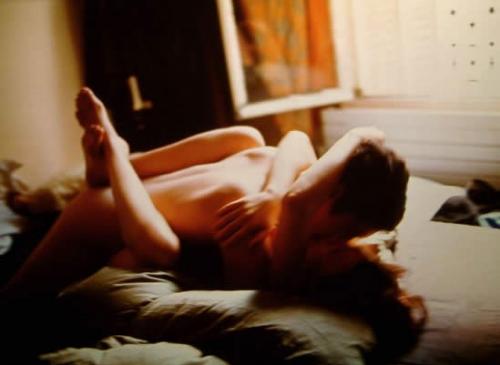
Nan Goldin


“This book is about beauty. And about my love for my friends”.

This are the words that Nan Goldin used to describe her book “The other side” published in October 1992. The title is inspired by a Club in Boston called The Other Side where she used to hang out with her friends. American artist Nan Goldin was born in Washington DC in 1953 and grow up in Boston, Massachuttes. From the first time she saw a drag queen she tought that she was the most gorgeous creauture she had never seen. Since then she has been constantly photographing the transexual and gay world. The artist was attracted by the freedom of these people beliving them as truly revolutionary and the real winners of the battles of sexes in society. Goldin’s style can be described as snapshots in its rawness and truth. She mostly photographs her subjects in enclosed spaces as bedrooms, bathrooms or night clubs.

The images usually figure intimate life moments such as sexual acts, family shots and portraits recording the world around her. I was impressed by the sponteneaty of her work and the passion and effort she put into her projects. She is shouting without any fear about the world she admires.

Bibliography:

·Nan Goldin, Guido Costa (Author), London: Phaidon 2001

·The ballad of sexual dependency, Nan Goldin, NY Aperture 1989

·The other side, Nan Goldin, David Amstrong, Walter Keller. Artist-in-residence-programme Berlin 1993

· artinfo.com/news/story/13609/nan-goldin/

Francesca Woodman


At the age of seventeen American photographer Francesca Woodman went to the Rhode Island School of Design.

She had almost no forniture when she moved in the industrial building in Providence while attending her studies in 1975.

There where just some sundry objects such as a fish bowl, animal furs, a mirror and some dead birds.

All enclosed in a space whose texture of scratched walls and wooden floors she found inspiration in this intimacy with her own space.

During her twenty-two years of life the artist produced a wide series of self-portraits.

Using the elements around her, she managed to create a total fusion with the sorroundings, capturing suspended moments leading to a state of mind.

Time and space are illusions, as the body itself magically appears and disappears in the squared frame.

Most of her black and white photographs show a ghostly presence of a young woman through different landscapes and places such as Rome, New york, Providence and MacDowell Colony.

The pictures above is part of a wide series took in the house she used to live in Providence.

The artistic combination between the soft intimacy of the bodies with the angularity of the geometric rules is at the base of incredible composition.

I choosed this work of Francesca Woodman because I found it inspiring for my last project and for a future one.

Bibliography:

·Francesca Woodman, Fondation Cartier pour l’art contemporain, Zurich 1998 France

·49thparallel.bham.ac.uk/back/issue15/rus.htm

· studio-international.co.uk/photo/woodman.asp

Michael Kenna


The interest in landscapes brought me to Paris, where English photographer Michael Kenna was exibiting at the Bibliotheque National de France his ‘retrospective’.

The artist has been travelling for over thirty years looking for magic atmospheres in landscapes and the influence of humans on them. His long exposures and the use of medium format, combined with black and white printing coneveys us nature’s beauty in relation to human traces. The sense of contemplation and the no-time no-space feeling is enhanced by the expert use of sepia tone and graduated filters. The exibition included 152 photographs, ranging from his early shots of industrial England and America, inspired by Bill Brandt up to the more recent views of french gardens of Versailles and Mont-Saint-Michel: sooty skyes, murky light and dreamy landscapes.

The exploration of different perceptions of light in Kenna’s French gardens, inevitably connects to the studies of haystacks by Claude Monet. He creates a powerful vision and forceful composition printed in a deliberately small format, fashinating the eye that researches for minute details.

Inspired by his photos I try to convey human struggle and their loneliness trough images of urban landscapes and abandoned buildings that relate to decaying forms,while in search of magical atmospheres and different perceptions of reality.

Bibliography:

· michaelkenna.net/

·Michael Kenna Retrospective, Bibliotheque Nationale de France, Bruno Racine (preface), Anne Biroleau 2009

·en.wikipedia.org/wiki/Michael_Kenna_(photographer)

· thenocturnes.com/resources/kenna.html

Sebastiao Salgado


In 1984 Sebastiao Salgado, one of the most respected photojournalist of our times, started a fifteen-month project in the drought regions of Africa. He concentrated on Chad, Ethiopia, Mali and Sudan. In this particular area of Africa approximatly one million people die from extreme malnutrition and related causes every year. Salgado had the great opportunity to collaborate with the Humanitarian Organization Doctors without borders while documenting one of the tragedies of our times. The photographer was born in Brazil in 1944 and after studies in economics he started working as an economist for the International Coffee Organization in Africa. While travelling he descovered the extreme poverty of african people and began photographing this cruel reality, switching his career to photography.The main point that the artist desired to show in his book “Sahel the end of the road” is the huge difference between the first world living a crisis of excess in comparison with the third world and its crisis of need. I love the work of Salgado, I respect his courage to show the reality of a world that our western society doesn’t consider. It makes me think about life, death and hope.

Bibliography:

·The Children: refugees and migrants. Sebastiao Salgado. Aperture NY 2000

·Sahel: the end of the road. Sebastiao Salgado University of California Press 2005

·Migrations: Humanity in Transition. Sebastiao Salgado. Aperture NY 2003

Eugene Richards


Eugene Richards is a noted American documentary photographer. Born in Dorchester Massachusetts 1944, graduated in English and journalism he later studied photography with Minor White at M.I.T. During the 1960s he was a civil rights activist and VISTA (Volunteers in Service to America) member. After the publication of his first two books, Few Conforts or Surprises: The Arkansas Delta (1973) and Dorchester Days (1978) Richards was invited to become a member at Magnum Agency. His work has appeared in a moltitude of publications including The New York Times Magazine, The Nation, Time, Newsweek and Life winning numerous awards. The artist is world wide known for his thirteen books and photo essays on such diverse topics as breast cancer, drug addiction, poverty, emergency medicine, pediatric HIV and AIDS, the meat packing industry, the plight of the world’s mentally disabled, anging and death in America. The photo-essay on inner-city communities devasted by the cocaine-crack epidemic brings into sharp focus the colossal failure of the war on drugs. His inspiring black and white photographs are described with interviews with dealers, drug users and police officers. Richard’s portrait are permeated by the reality of drugs and isolation in North Philadelphia, Brookling, East New York and Reed Hook. It describes with intense accuracy the havoc drugs wreak on lives, families as cocaine and heroine addiction intersect with poverty, AIDS, homelesnes, and availability of guns that affect every American City. I believe he is penetrating and painful.He is one of the masters of photo-journalism in the way he can get close to people and make them feel confortable enough to trust him. He brings pain and true reality in front of us.

Bibliography:

·The blue room, Eugene Richards Phaidon 2008

·Cocaine Blue Cocaine True Eugene Richards 1994

·Eugene Richards Phaidon Press 2001

·amazon.com/Cocaine-True-Blue-Eugene-Richards/dp/0893816876

·goodreads.com/book/show/83924.Cocaine_True_Cocaine_Blue